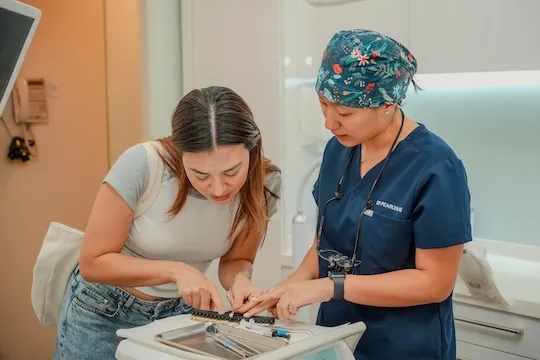
Many patients start by telling me they want a perfect smile — straight, even, white. It is a completely fair thing to ask for. But perfect turns out to be a slippery word. We have all inherited more or less the same picture of it, and it usually takes a proper conversation before I understand what any one person actually means when they use it.
Because that inherited picture — the generic one — is often not what someone truly wants once they see it on their own face. A computer can draw a perfect circle. It can line a row of teeth up like piano keys, match them to a single flat shade of white, and space them with flawless symmetry. Put that in a real mouth and it rarely looks beautiful. It looks manufactured. You can’t always explain why, but you can tell something isn’t quite right.
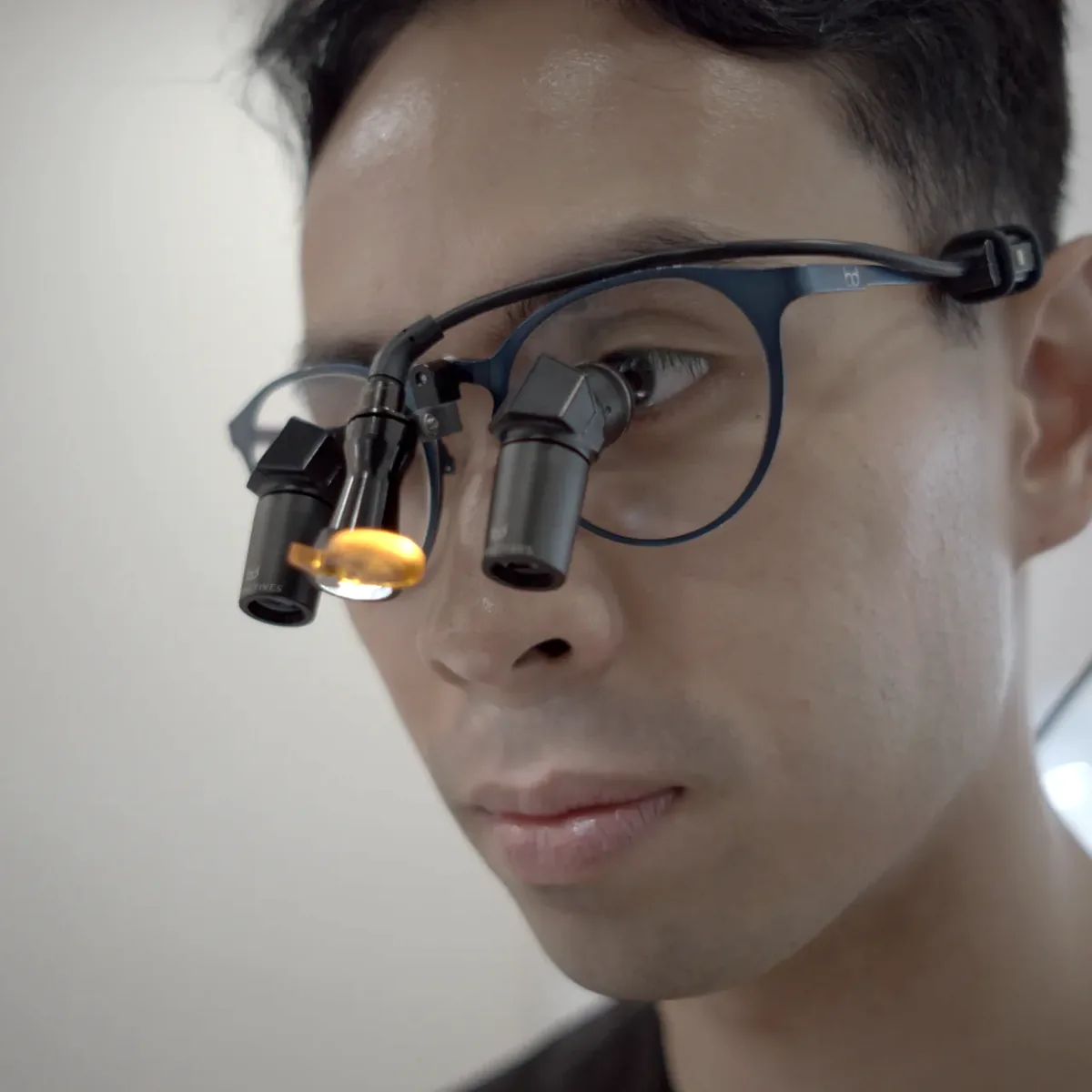
Perfect is easy to specify: straight, even, one bright white. Natural is the harder job — giving each tooth its own length, texture and shade, so the set looks like it grew in one mouth rather than off one mould.
What a natural smile is actually made of
Real teeth were never meant to be identical. Within one mouth, no two share the same shape, the same worn edge, or quite the same colour — and none of that is a defect. It is exactly what marks a set of teeth as one person’s own, at one point in their life. Reproduce it too cleanly and a smile turns generic.
A natural-looking smile is designed — carefully. The difference is that good design keeps those small irregularities on purpose. My job is to read the face in front of me, decide which quiet imperfections belong to it, and build them in so precisely that no one — including you — can tell the smile was planned at all.
Done well, the change is strangely hard to point to. People notice you look better but can’t say why — they will guess more sleep, a good holiday, a new haircut, anything but the dentist. That is not them failing to notice. It is the whole aim: the work is felt long before it is seen, and most of the time it is never seen at all.
That, more often than not, is what a person meant by “perfect” in the first place. They simply didn’t have the word for it yet.
How a natural smile is actually built
None of this is guesswork. Before I design anything, I work through a structured assessment we use at the practice — the 18-Point Smile Analysis — which looks at a smile across three levels. It sounds clinical, but it simply follows the order you take in a face — the big picture first, then the fine detail — and it is where natural is won or lost.
Macro is the big picture: how the smile sits on the whole face — how much tooth shows when you are relaxed, how much gum appears when you smile, whether everything lines up with the midline of your face. Get this wrong and even flawless teeth look borrowed from someone else.
Mini is what people actually see across a table — the curve your teeth trace against your lower lip, the way they are arranged, the softly shadowed corners at the edge of a smile.
Micro is where naturalness really lives. The surface texture that catches the light. The way colour deepens near the gum and turns faintly translucent at the tip. The tiny triangular spaces where teeth meet. The direction each tooth quietly leans. Nine small details — and every one is a chance to make a smile look real, or to make it look printed.
Leave them out and you have drawn the perfect circle. Build them in, deliberately and in proportion to the face, and you have a smile no one would think to call designed at all.
Symmetry is the usual giveaway. Real faces aren’t symmetrical — and the smiles that suit them aren’t either.
What you actually meant by perfect
Getting this right has less to do with dentistry than with paying attention. Before I look closely at anyone’s teeth, I want to understand the person they belong to.
So the first proper conversation is rarely about teeth at all. It is about you — what you notice in the mirror, what you have never liked, what you would want a stranger to see. I watch how your face moves when you talk and laugh, because a smile has to belong to that, not to a chart. Only once I understand the person do I start designing the smile.
A good part of that is simply how we talk about the work. I would rather you understood every option in front of you and made the decision yourself than nodded along to something you didn’t quite follow. The clinical calls have to be right — that part isn’t up for debate — but how your smile looks is yours to decide, not mine, and I would sooner slow down than have you agree to something you can’t yet picture.
So when someone tells me they want a perfect smile, I don’t take the word at face value — I ask what it means to them. Almost always, once we talk it through, the thing they are reaching for isn’t the generic ideal at all. It is a smile that looks unmistakably like them, on their best day. That is a brief I can happily design to.
If that’s the kind of smile you’d like — one that looks unmistakably like you — come and have a chat. No bracing yourself required.