
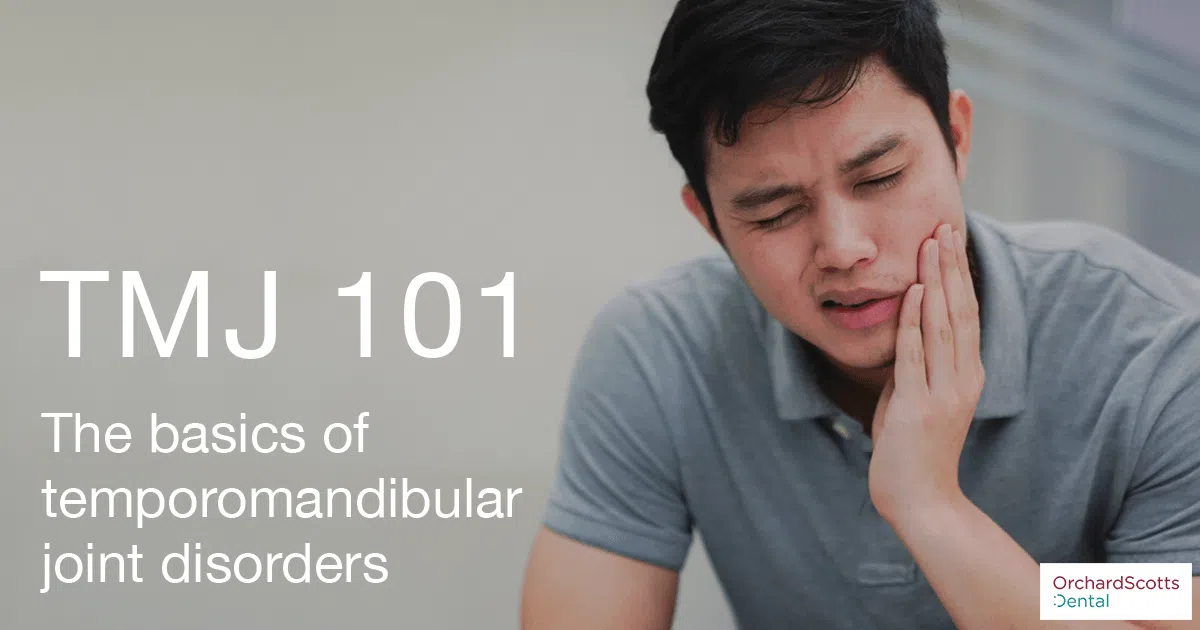
The jaw is the joint you use most and think about least. It moves every time you speak, chew, yawn or laugh — thousands of small movements a day, almost none of them conscious. Most of the time it does this quietly. When it stops being quiet, the discomfort can range from a faint clicking to a persistent ache around the jaw, ears or temples.
Occasional, mild jaw discomfort is common and often settles on its own. It is when the symptoms persist or build over time that they are worth a closer look — they may point to what is grouped under the heading of temporomandibular disorders.
The joint, briefly
The temporomandibular joint connects the lower jaw to the temporal bone at the side of the skull. Rest your fingers just in front of your ears and open your mouth, and you can feel it work. Unlike the hip or knee, it is a joint that moves in more than one direction — up and down, and side to side — which is what lets you chew and speak. A small cushioning disc inside the joint absorbs the load and keeps the movement smooth.
That versatility is also what makes it complex. When something in the system is out of balance — the disc, the muscles, the way the teeth meet — the joint can become uncomfortable, and the discomfort can be surprisingly hard to pin down, because so much converges in one small space.
A note on terms, since they are used loosely. TMJ refers to the joint itself; TMD, temporomandibular disorder, is the broader heading covering problems of the jaw muscles, joint and surrounding nerves. People tend to say “TMJ” for both. The distinction matters less than understanding what is going on underneath.
Why the bite is so often involved
This is the part I find patients are rarely told. A great deal of jaw discomfort traces back not to the joint in isolation but to the bite — how the upper and lower teeth meet when they come together. If they do not meet evenly, the muscles compensate. They work harder on one side, hold tension where they should relax, and over months and years that imbalance can show up as fatigue, ache or clicking in the joint.
A jaw that hurts is often a jaw that has been quietly compensating for a bite that does not quite meet — the symptom is in the joint, but the cause is frequently in how the teeth come together.
Misaligned bites — an underbite, a pronounced overbite, or crowded teeth that do not align cleanly — are common contributors. So is habitual clenching or grinding, often done in sleep without any awareness of it, which loads the joint and muscles night after night. None of these guarantees a disorder. But they are the patterns worth looking for first.
What it can feel like
The signs vary, which is part of what makes self-diagnosis difficult. Soreness along the jaw, neck or face. Difficulty opening the mouth fully, or a sense that it catches. A clicking or grating when you chew. Headaches, particularly around the temples. Sometimes ringing in the ears or worn-down teeth that point to grinding. Any of these on its own may mean little; several together, persisting, are a reason to have the bite assessed properly rather than to interpret it yourself.
How we approach it
My instinct, and the practice’s, is to start with the bite rather than the symptom. Settling jaw discomfort durably usually means understanding why the joint is under strain — and that means looking at how the teeth meet, how the muscles are working, and whether alignment or a grinding habit is doing the quiet damage. We assess the bite first, then treat the cause we find, rather than managing the ache and leaving its source in place.
Where clenching, grinding or a strained bite is driving things, that is the ground our bruxism and TMJ treatment works on — relieving the load on the joint and, where appropriate, addressing the underlying bite so the relief holds. The aim is comfort that lasts, not a temporary quiet.
If this resonates
If your jaw has been clicking, aching, or waking you with tension around the temples, it is worth a proper assessment of the bite rather than a guess at the cause. Arrange a consultation and we will look at what is actually driving it.