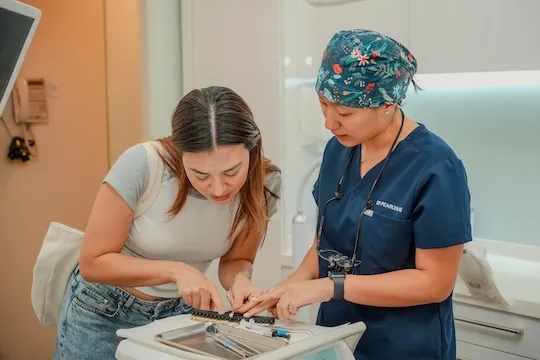

Whitening is often the first cosmetic treatment people consider, and with reason — it asks little, changes a great deal, and leaves the tooth itself untouched. But the question worth asking before any of that is a quieter one: why have the teeth darkened in the first place? The honest answer decides whether whitening will do exactly what you hope, or very little at all. The colour of a tooth has more than one cause, and the cause is what matters.
Two kinds of staining
It helps to sort discolouration into two families, because they behave quite differently once a whitening agent reaches them.
Extrinsic staining sits on the outside of the tooth — the residue of what passes over the enamel day after day. Coffee, tea, red wine, the tannins in richly coloured food, and above all tobacco, which is among the most reliable causes of yellowing there is. Because this kind of staining lives on a surface a treatment can reach, it tends to respond well to whitening.
Intrinsic discolouration comes from within. The commonest version is simply age: enamel thins over the decades, and as it does the darker dentine beneath begins to show through. Other causes are less visible — certain antibiotics taken in childhood, an excess of fluoride during the years the teeth were forming, the aftermath of an injury to a single tooth, or plainly genetics, since some people are prone to a warmer shade. This family does not answer to surface treatment in the same way, which is precisely why a look comes before a gel.
How professional whitening is done
There are two routes, and they suit different people rather than ranking against one another.
In-clinic whitening is carried out over one or two sessions in the chair. The teeth are first cleaned, so the agent meets the enamel directly rather than working through a film of surface stain, and a controlled, higher-strength gel is applied under supervision. It is the quicker route, and the strength is matched to your teeth as the session goes.
Take-home whitening uses custom trays moulded to your teeth and a gentler gel worn for a set period each day over a couple of weeks. It is slower and more gradual, which some people prefer — the change arrives quietly, and the trays stay useful for the occasional top-up later. Often the two are combined: a session in the clinic to set the shade, trays to hold it.
Either way, the gel only works on healthy, natural tooth. It cannot lighten a crown, a veneer, or a filling, and where decay is the reason a tooth has darkened, that has to be addressed before any brightening is sensible. Establishing this first is what separates a result that holds from one that disappoints.
Comfort and how long it lasts
Whitening is usually comfortable. Some people notice a passing sensitivity to cold or sweetness for a day or two — that is the agent reaching the dentine, and it settles. A desensitising gel manages it where it occurs, and easing off very cold or hot drinks for the first day helps. There is nothing to brave here.
How long the result holds depends largely on how it is looked after. For most people the brighter shade lasts from several months to a few years, and the variable is lifestyle as much as anything — the same coffee, wine, and tobacco that dulled the teeth the first time will gradually do so again. None of that undoes the result; it simply means an occasional top-up keeps it where you want it.
The useful question is never simply how to whiten teeth, but why these particular teeth are the colour they are — because that is what tells you whether whitening is the answer or the wrong tool.
The way we think about it
We start by reading the discolouration rather than treating it on sight — what kind it is, how deep it sits, and whether the gums and enamel are sound enough for whitening at all. Where whitening is the right tool, it sits comfortably alongside other work: it is often done to even the shade before a restoration is matched to it, or to settle the colour after a course of Invisalign, so the finished smile reads as one piece. Where the colour has a cause whitening cannot reach, we will say so, and talk through what would.
If this resonates
If your teeth have lost some of their brightness and you would like to understand why before deciding what to do about it, that is the right instinct. The place to begin is an assessment of the cause, which is what tells you whether professional teeth whitening is the answer or the wrong question. Arrange a consultation and we will tell you plainly what we see, and which approach, if any, suits your particular case.