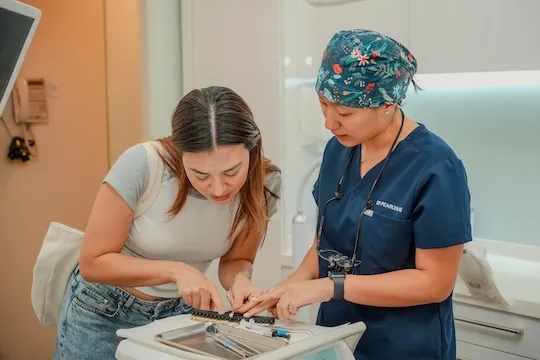
Almost every week, someone sits down across from me and asks a version of the same question.
Sometimes it is phrased directly: “Is Invisalign the right choice, or should I be looking at veneers?” Sometimes it is more personal: “My colleague had Invisalign, but my friend says veneers are faster — what would you recommend?” Occasionally someone has done enough research to arrive at their own answer: “I have decided I want veneers. Can we talk about that?”
They have already done the homework. They have watched the videos, read the comparison articles, scrolled through clinic accounts. They arrive with information — sometimes a great deal of it.
My job in those moments is not to confirm or contradict what they have found. It is to ask them a different question.
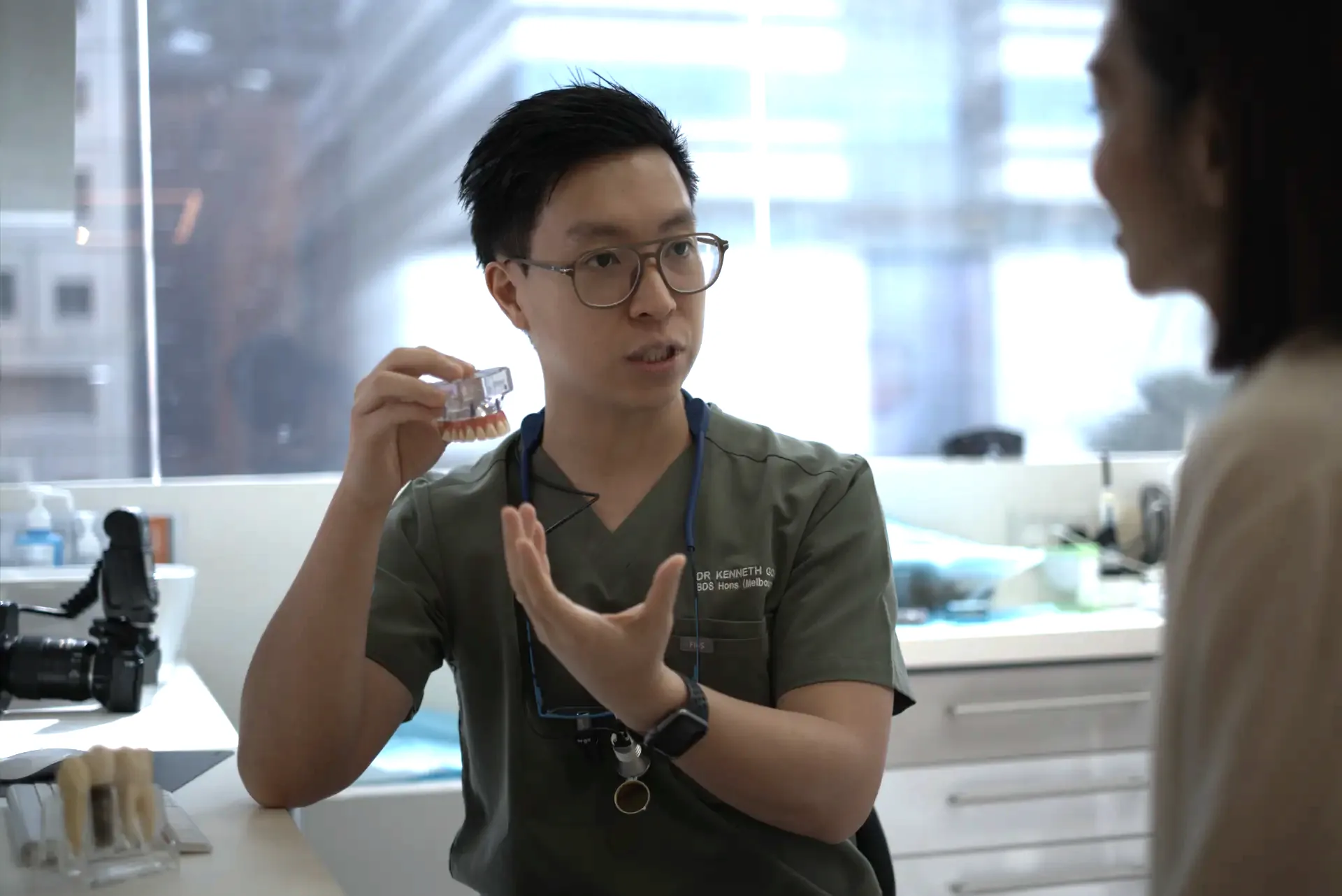
The question behind the question
Here is what I have learned after more than a decade working across both orthodontics and aesthetic dentistry: the choice between Invisalign and veneers is almost never the real question. The real question is — what does this particular smile actually need? And that cannot be answered without proper diagnostic work.
I am an Invisalign provider, and I believe deeply in what well-executed orthodontic treatment can do — not only for appearance, but for function, bite health, and long-term stability. I also work at a practice that has placed thousands of veneers over nearly two decades, alongside an in-house ceramist and dentists who have spent their careers refining aesthetic smile design.
I sit at a useful intersection. Both tools are extraordinary. Both have specific indications. The mistake is treating them as interchangeable.
What each one actually addresses
Invisalign moves teeth. That is its job, and it does it well. When teeth are crowded, spaced, rotated, or sitting in an incorrect bite relationship, orthodontic treatment corrects the position — so the teeth sit in better relationship with each other, with the jaw, and with the face.
Veneers, in the context of our SmileUp™ programme, do something different. Rather than moving teeth, they redesign the teeth themselves — the shape, the proportion, the form, the way light sits on them. SmileUp is suited to patients whose teeth are fundamentally in the right position but whose smile design needs rebuilding: teeth that are worn, chipped, too small, or proportionally mismatched for the face they belong to.
Why smile design diagnostics matter
Almost everything turns on the diagnosis. Done properly, it is what reveals whether a smile needs repositioning, redesign, or both — and it is the only honest basis for recommending one path over another. Without it, you are guessing, however confident the guess sounds.
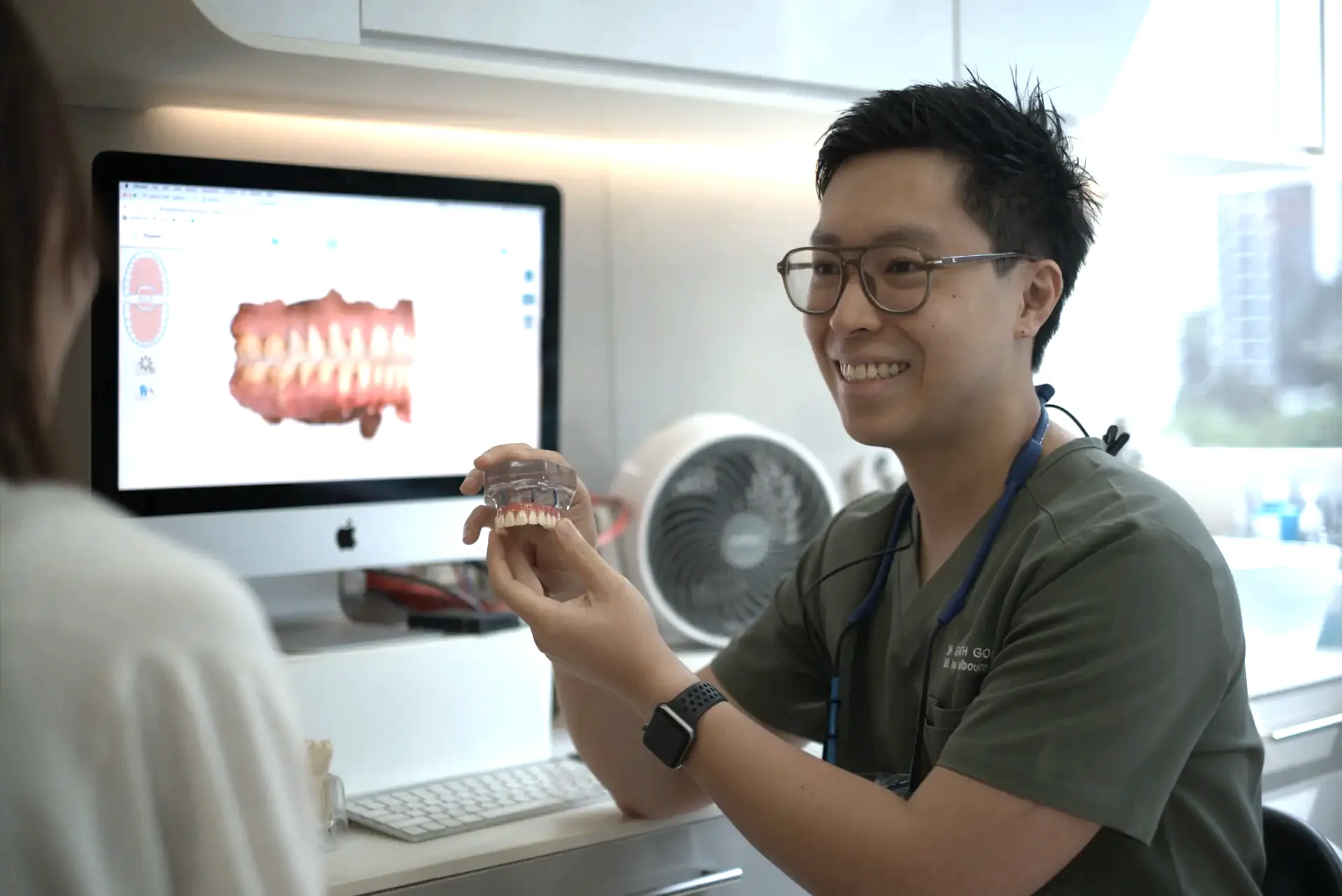
Our structured evaluation considers not just the teeth in isolation, but how they relate to the lips, the gum line, facial symmetry, and the midline of the face — across five macro checkpoints, four mid-range, nine fine-detail.
The assessment takes 60 to 90 minutes. The industry standard is 20 to 30. That extra time isn't inefficiency. It's the entire point.
A thorough diagnosis also settles the order of treatment. When a case genuinely needs both — mild crowding that affects the bite, alongside imperfections veneers would address — the sequence is almost always orthodontics first, veneers after. Place veneers on teeth that will later move and you risk compromising both. That ordering is not a detail; it falls straight out of the diagnosis, which is exactly why the diagnosis comes first.
The honest part
I want to say something directly, because I think it matters.
There are situations where the honest answer to “should I get veneers?” is: not yet, or not necessarily, or perhaps not at all. A patient whose dissatisfaction stems mainly from alignment — whose teeth have good shape but simply are not sitting in the right places — is often better served by orthodontic treatment. It is less invasive, the result is more naturally integrated when the indication is right, and it preserves tooth structure in a way that redesigning the teeth does not.
Patients can finish orthodontic treatment with well-positioned teeth that still do not look the way they had hoped — because alignment was never the core issue.
Neither outcome reflects well on the profession. Both are avoidable with proper diagnostic rigour.
The conversation worth having
When I sit down with a patient, I am not trying to steer them toward any particular treatment. I am trying to understand their smile, their face, and what they are actually hoping to achieve. Sometimes that confirms what they already suspected. Sometimes it opens a different conversation entirely.
What I can promise is this: the recommendation that comes out of that conversation will be grounded in what I observe clinically — not in what is most convenient. That is the only basis on which I am willing to put my name to a treatment plan.
If you are trying to decide between orthodontics and cosmetic dentistry, the best place to start is not an article, a forum, or a comparison video. It is a proper clinical assessment.
Come in and see us — we’ll take a proper look at your smile, and tell you honestly what it needs, and what it doesn’t.