The market for clear aligners has widened in recent years. Alongside clinic-based treatment, a number of direct-to-consumer companies now post aligners to your door, planned remotely and worn without in-person appointments. They are often presented as the same product with the overheads stripped out. The trays may look similar — but the difference that matters is not the plastic. It is the clinical supervision around it.
What the two approaches share
At a glance, the appliances do resemble one another. Both use smooth, removable trays that move the teeth roughly a quarter of a millimetre at a time in a planned direction. Because both are removable, both make cleaning easier than fixed braces, and studies suggest aligners of either kind carry a lower risk of plaque accumulation and gum inflammation than brackets and wires.
The trays also differ in fit. Invisalign trays are scalloped and individually customised to sit closely against each tooth; many mail-order kits work from more generic designs, which is part of how the cost is kept low.
What supervision actually does
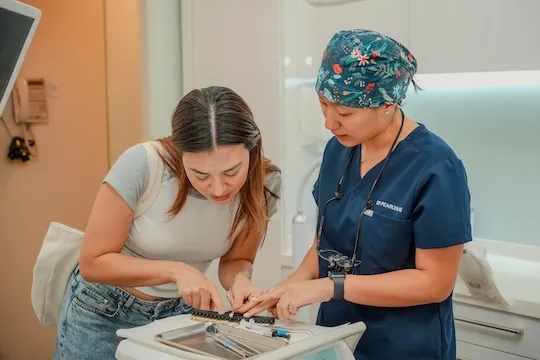
The substantive difference is what surrounds the treatment. Clinic-based aligner treatment begins with a full assessment of the teeth and gums, and the progress of each stage is monitored — in person or remotely through a monitoring app — so the plan can be adjusted if the teeth are not moving as expected. Mail-order kits generally remove that step, relying on impressions or scans the patient takes themselves.
This matters because moving teeth is a biological process with real margins for error. Aligning teeth without first assessing the condition of the gums and bone underneath can cause problems, and a self-taken impression leaves more room for inaccuracy than a clinical scan. The American Dental Association has advised caution about unsupervised mail-order aligners on exactly these grounds, and orthodontic bodies have reported cases of patients needing corrective treatment after using them. The point is not to alarm — it is simply that supervision exists to catch problems before they become difficult to undo.
The trays are the easy part. What you are really choosing between is treatment with clinical oversight and treatment without it.
Where each one fits
Mail-order kits are designed for mild to moderate cases, and for someone with straightforward teeth and a clear understanding of the trade-off, they can have a place. Cases involving complex movements, bite restructuring, or any existing gum or bone concern sit outside what an unsupervised kit can safely handle.
Singapore is a small country, and in-clinic monitoring is rarely a question of distance here. For most people, the practical decision is simply whether the lower upfront cost of a mail-order kit is worth treatment without a clinician watching how the teeth respond.
The way we think about it
We plan every case around three considerations — biology, function, and aesthetics. The bite has to function, the result has to stay healthy, and the finished smile has to belong on your face. Supervision is how those considerations are kept in view from the first scan to the last tray, rather than assumed at the start and hoped for at the end.
If this resonates
If you are weighing a mail-order kit against clinic-supervised aligners, the useful step is an assessment of your own teeth and gums, so you can decide with the full picture in front of you. Arrange a consultation and we will tell you plainly what your case needs, and whether aligners are the right tool for it.