
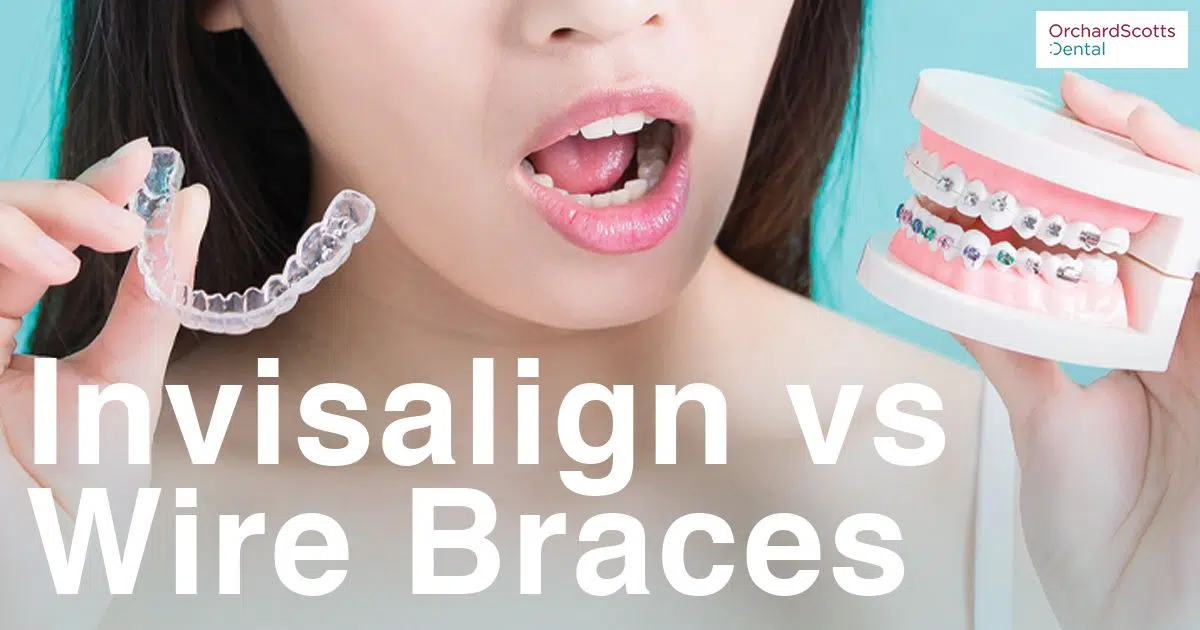
When people compare clear aligners with wire braces, the conversation usually fixes on the obvious — how visible each one is. The more useful comparison is what is happening beneath that, where the two appliances genuinely differ: how they affect the gums, how easy the teeth are to keep clean during treatment, and what each asks of you day to day. None of this points to a single right answer. It points to a set of trade-offs you can weigh against your own circumstances.
How each appliance works
Wire braces use metal or ceramic brackets bonded to the teeth, with a wire that is tightened at intervals to draw the teeth into position. Because the appliance is fixed, it works continuously and is well suited to complex repositioning and bite restructuring.
Invisalign uses a sequence of clear, custom-made trays that move the teeth roughly a quarter of a millimetre at a time, each in a planned direction worked out from a digital model of your mouth. The trays are removable, which shapes much of what follows.
What the evidence suggests
A six-month study of 139 orthodontic patients, aged between 11 and 62, looked at gum health during treatment with each appliance. All the patients were given the same oral hygiene regimen and the same professional cleaning. The aligner group recorded lower gingival inflammation and less plaque accumulation; the braces group showed more plaque build-up, with a greater tendency towards decalcification and white-spot marks on the enamel.
The reason is not mysterious. Brackets and wires create more surfaces for plaque to gather on and more obstacles for a toothbrush to navigate. Removable trays come out for cleaning, so the teeth can be brushed and flossed normally. This is a real advantage of aligners — but it depends entirely on the trays being worn consistently, which not everyone manages.
Where each one fits
Cleaning and gum health. Aligners come out, so a normal brushing and flossing routine carries on uninterrupted. Braces ask for more care and often some extra equipment — an interdental brush or water flosser — to clean around the fixtures.
Durability and complexity. Braces are robust and handle highly technical movements and bite work that aligners cannot. They can, occasionally, cause soreness or minor cuts to the cheeks. They also suit anyone likely to misplace a removable tray — younger children, or simply the forgetful.
Lifestyle. Aligners fit busy schedules with fewer interruptions and no dietary restrictions, which appeals to many adults, teenagers, and athletes. The condition, again, is consistent wear; the speed of treatment depends on the force applied and on the trays staying in.
The way we approach it
Both appliances treat misaligned teeth; the question is which suits your particular case. Straightening is rarely only about straightness — the bite has to function, the result has to stay healthy, and the finished smile has to belong on your face. Those three considerations, biology, function, and aesthetics, guide how we plan every case, and they are what a careful assessment is for. We favour conservative, non-invasive treatment wherever the case allows it.
If this resonates
If you are weighing aligners against wire braces, the useful step is an assessment of your own teeth rather than a comparison in the abstract. Arrange a consultation and we will examine your bite, talk through your priorities, and tell you plainly which approach we would recommend, and why.