
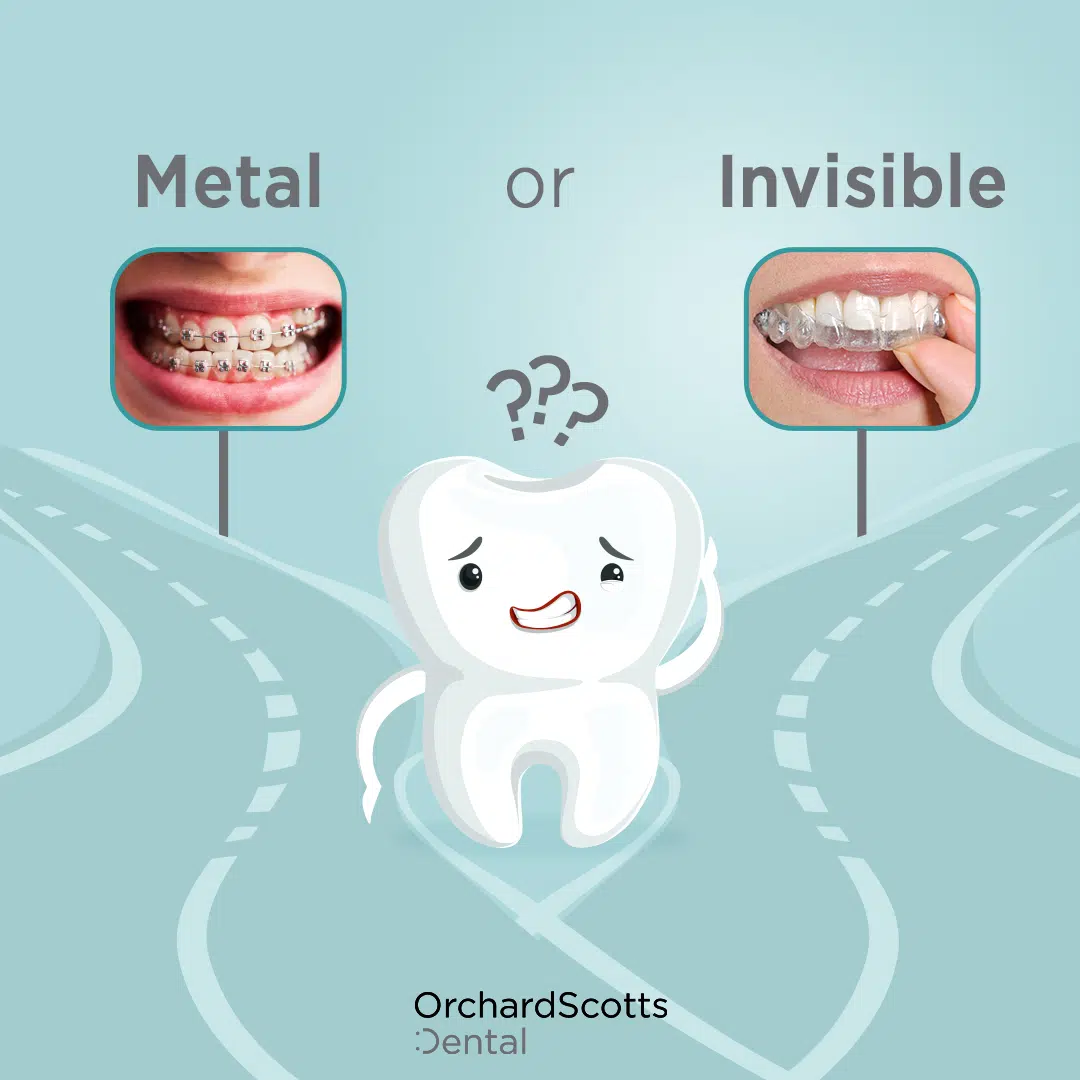
Most people picture bulky metal braces when they think about straightening their teeth — and for a long time that was the only picture available. Clear aligners are a more recent arrival, and the two now sit alongside each other as genuine alternatives. Neither is the right answer in the abstract. The right answer is the one that suits your case and the way you live.
Metal braces, in brief
Modern metal braces are far more streamlined than the versions of decades past. Small brackets are bonded to the enamel and joined by a wire; at regular intervals the orthodontist adjusts the wire, and the teeth move gradually into position.
Because braces are fixed in place, they work continuously and ask nothing of your memory. They handle a wide range of cases, including complex ones, and they are well suited to anyone who knows that a removable appliance would simply end up in a drawer. The trade-off is visibility — they are more noticeable than aligners — and a little more effort around cleaning, since brushing and flossing have to navigate the brackets and wires. People who play contact sports usually need a mouthguard fitted around them.
Clear aligners, in brief
Clear aligners such as Invisalign take a different route. A planned sequence of transparent, custom-made trays moves the teeth a fraction of a millimetre at a time, each tray worn for a week or two before the next. The trays are made from a smooth, BPA-free material and are close to invisible in everyday wear.
Their great advantage is that they come out — to eat, to drink anything other than water, and to clean your teeth — so nothing is off the menu and oral hygiene stays straightforward. That same removability is also their one condition: aligners only work if they are worn twenty to twenty-two hours a day. They suit a wide range of cases, though some — certain bridgework, or movements requiring significant rotation of canines and premolars — are better handled by other approaches.
How to weigh it
The first factor is always the clinical one — what your teeth and bite actually need. A careful assessment settles much of the question before preference enters into it. After that, two practical considerations tend to decide things: how visible you are willing for the treatment to be, and how reliably you will keep a removable appliance in.
Someone who travels constantly and values discretion may lean towards aligners. Someone who would rather not think about the appliance at all may be better served by braces that simply stay put and do the work. Both routes end in the same place — teeth that sit more evenly and a bite that functions better — by different means.
The way we think about it
Straightening teeth is rarely only about appearance. A smile has to work as well as it looks: the bite has to meet evenly, the result has to stay healthy, and it has to belong on your face. Those three considerations — biology, function, and aesthetics — guide how we plan a case, whichever appliance we recommend. The appliance is a tool; the judgement behind the plan is what shapes the outcome.
If this resonates
If you are deciding between braces and aligners, the useful step is an assessment of your own teeth rather than a comparison in the abstract. Arrange a consultation and we will examine your bite, talk through your goals, and tell you plainly which approach we would recommend in your case, and why.