Misaligned teeth are usually filed under appearance — something you might correct if it bothers you, and leave alone if it does not. That is a fair personal judgement, but it overlooks the quieter case for alignment, which has less to do with how a smile looks and more to do with how it holds up over time. Teeth that meet evenly are easier to keep clean and distribute the load of a bite as they were meant to. Teeth that do not can ask more of the mouth than is comfortable in the long run.
What misalignment actually is
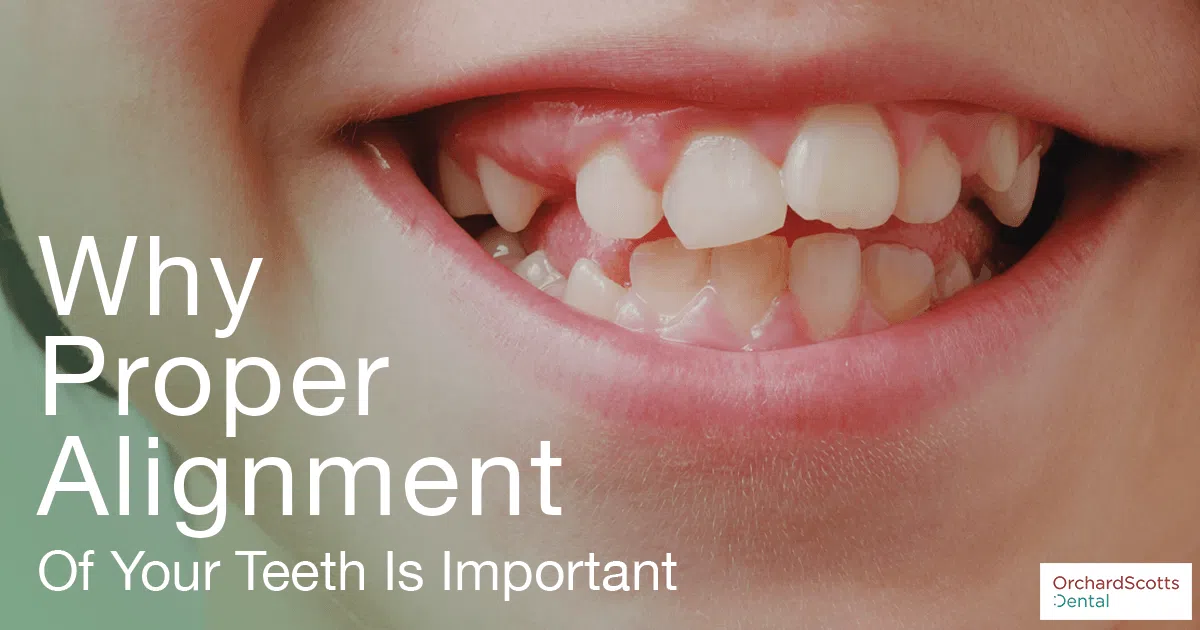
Misalignment — clinically, malocclusion — simply means the teeth do not sit or meet as they ideally would. Often there is more tooth than there is room, and the teeth crowd and overlap. Sometimes the upper and lower jaws do not align, producing an over- or under-bite. Much of it is inherited, in the same ordinary way as eye colour or height; some of it follows from childhood habits, early loss of milk teeth, or injury. None of this reflects a failing on anyone’s part — it is simply how a particular mouth has developed.
Why it is worth understanding
Crowded, overlapping teeth are harder to clean well. Tight spaces trap plaque that a brush and floss cannot fully reach, and over time that raises the risk of decay and gum inflammation. This is not cause for alarm — good hygiene and regular gum care manage it well — but straighter teeth make that daily maintenance more achievable, which is part of the point.
A bite that does not meet evenly also loads the teeth and jaw unevenly. That can wear the enamel down in places and, in some people, contribute to tension in the jaw muscles and joint. It can shape how clearly certain sounds are formed in speech, and how thoroughly food is broken down when you chew. These are tendencies, not certainties — many people live comfortably with a degree of misalignment for a lifetime. The reason to address it is not fear of what might happen, but the steady, practical benefit of a bite that works with less strain.
The confidence side of it
There is also the part that does not show up on an X-ray. People who feel self-conscious about their teeth often hold back a smile in exactly the rooms where it would serve them — a meeting, an introduction, a photograph. That is a real cost, even if it is not a clinical one, and for many people it is reason enough on its own to consider treatment. A smile you are comfortable with is not a vanity; it changes how readily you use it.
Alignment sits at the meeting point of health and confidence — and the most considered treatment serves both at once.
How alignment is corrected
Where the teeth themselves are healthy and the issue is position, the most conservative route is usually to move them. Clear aligners do this with a planned sequence of transparent, removable trays — discreet, and gentle on the cheeks and gums compared with fixed appliances. They handle crowding, spacing and many bite irregularities well; more complex cases are sometimes better served by other orthodontic approaches, which a thorough assessment identifies. The aim throughout is the same: a bite that functions, a result that stays healthy, and a smile that belongs on your face.
If this resonates
If your bite or the position of your teeth is something you would like to understand better, the place to begin is an assessment — what is actually going on, and whether it is worth addressing in your case. Arrange a consultation and we will tell you plainly what we see, and what we would and would not recommend.