Most people considering an implant are not anxious about the idea of it — they are anxious about the parts they cannot picture. So this is a plain walk through what actually happens, stage by stage, so the process feels less like a leap and more like a sequence of considered steps.
Pre-procedure consultation
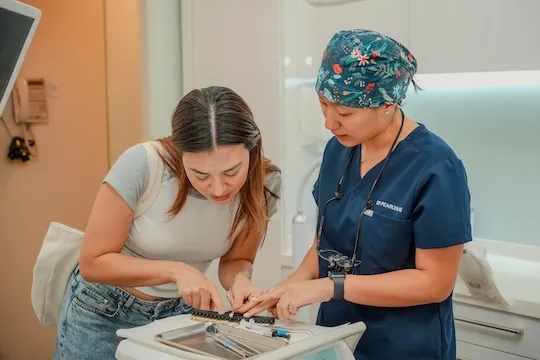
A dental implant begins with an assessment, not a procedure. At this first appointment, the dentist examines your overall dental health to establish whether an implant is the right tool for your particular case.
You will undergo a series of checks — including X-rays and 3D imaging — to evaluate your bone density, gum health, and the position of your remaining teeth. The dentist will also assess whether your jawbone is strong enough to support the implant. Where it is not, a bone graft may be recommended first.
Medical history and health considerations
Before anything proceeds, your complete medical history is discussed. Certain conditions — diabetes, heart disease, or immune system issues among them — can bear on how well an implant settles.
Your dentist will want to know about any medications you take, including blood thinners or those for osteoporosis, as these can affect healing. From that picture, a treatment plan is tailored to minimise risk and give the implant the best chance of integrating well.
Dental preparations
Once you have been assessed as a suitable candidate, preparations begin. If damaged teeth need replacing, they are extracted before the implant goes in. For some patients, the implant can be placed in the same appointment as the extraction — but this depends on the health of your gums and jawbone, which is exactly the kind of judgement the assessment exists to make.
Nutritional guidelines
Good nutrition supports healing. In the days leading up to surgery, your dentist may advise increasing nutrient-dense foods rich in vitamins and minerals — particularly vitamin C and calcium — to support bone health.
Managing anxiety
Surgery makes most people uneasy, and that is worth raising rather than carrying quietly. Discuss any concerns with your dentist beforehand. A range of sedation options — oral sedatives, nitrous oxide, or intravenous sedation — are available to keep you comfortable, and your dentist will talk you through each step so you know what to expect on the day.
The procedure
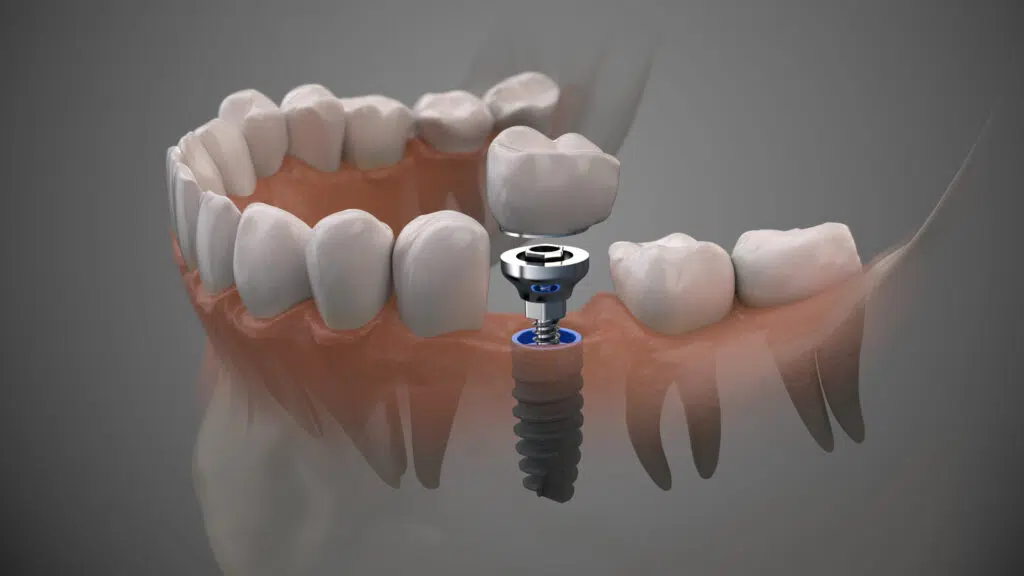
On the day, the area around the implant site is numbed with anaesthesia. The dentist makes a small incision in the gum to reach the jawbone, then prepares a precise channel where the implant — a titanium post — is placed.
That post acts as an artificial root. Once it is secured, the gum is stitched closed over it. Sometimes a temporary crown is fitted to preserve the look of your smile while the bone fuses with the implant — a process called osseointegration, which takes several months and is the mechanism by which the implant becomes permanently anchored.
When fusion is complete, a small connector called an abutment is attached, and the permanent crown is placed on top. The crown is matched to your natural teeth in colour, size, and shape, so it belongs in the smile rather than stands out.
Post-procedure care
Afterwards, your dentist will give detailed aftercare instructions, typically covering:
- Managing discomfort: Over-the-counter pain relief such as ibuprofen usually settles the first few days; your dentist may prescribe something if needed.
- Keeping the site clean: Good oral hygiene matters, but be gentle near the implant — use a soft-bristled brush and avoid the surgical site for the first few days.
- Reducing swelling: An ice pack against the cheek near the site helps.
- Resting: Strenuous activity can increase swelling or bleeding, so a few quiet days are sensible.
Follow-up appointments are scheduled so your dentist can monitor healing and confirm it is progressing as it should.
How we think about it
A replacement tooth has to satisfy three things at once — it has to stay healthy in the bone, function comfortably under a real bite, and belong in the smile. Biology, function, and aesthetics guide how we plan every implant, from the first scan to the final crown. The process can take time, but the result is a lasting, natural-looking replacement cared for much like a natural tooth.
If this resonates
If you are weighing up a missing tooth and want a straight account of whether an implant is the right route, the place to begin is a proper look at your bite, your bone, and your goals. You can read more on our dental implants page, and arrange a consultation when it suits.